Showing posts with label tengal. Show all posts

Friday, November 11, 2011

CLIMAX PROJECT PREMIERES AT KINO SISKA, LJUBLJANA THIS NOV 23


More info: http://www.kinosiska.si/sl/dogodki/eksperiment/2011-11-23/climax_stigma_filmski_dogodek_po_motivih_barthesovega_diskurza_ljubezni/430/
(In Slovene, please use English version of the site)

Monday, April 26, 2010

Updates: New Work for live cinema performance and sound installation

AS the atypical revolutionary slogan indicates:
"WORKERS OF THE WORLD, RELAX!"
As for me, there won't be any chillin' chez moi just yet...

Two premieres on the same day, May 2!


New live cinema project:

Treatment for Film in 9 Scenes (live performance)

Sampled footages from various movies, videos from youtube, and the internet, are taken out of their original context and placed into a meta-narrative of what may seem to be a series of unrelated fragments juxtaposed to create a new movie. The performance investigates the possibilities of creating new forms of narratives amidst an overload of sensory experience. Sounds, like field recordings, Foley sound effects, and electronic noise, are transformed further away from their original sounds and often never correlate to the images seen on screen. To counter the chaos, the audience is invited to close their eyes during the performance, while two different sound cues are played for them. Upon hearing the sound cue, the audience is invited to open their eyes to follow either one of the two parallel narratives that can be found in the rapid flow of data stream. The work is at first a deep investigation on listening, then the combination of listening and viewing.

“Treatment for Film” is an experiment on finding a balance in ambiguity and specificity, where the mind’s activity of reading or deriving meaning from signs, can help create individualized cinematic narratives with the images and sounds they perceive. The perception of order produces pleasure.

“Treatment for Film” is literally “performed cinema”, where it makes the usual passive audience into an active participant of the movie making process.


*Treatment will premiere at The Substation in Singapore during the cool new monthly program called Rooted in The Ephemeral Speak (R.I.T.E.S.) by intermedia artist-curators Kai Lam and Wen Lee. Other equally interesting performances by local Singapore sound artists are also slated on the same event. Cai Qing, Marc Chia (One Man Nation), Debbie Ding, and Zai Tang.


If you happen to be in Manila on the same day, despite being unable to perform with TEARS FOR FEARS for their Manila tour, I have a sound work installed at Manila's (in)famous Luneta Park (Rizal Park) for Innovative Noise Collectives' "Noises at the Park" concert. A pun on the monthly "Concert at the Park" events held at Luneta -- "Noises" will be all about good old volume destruction. Though I find the program a bit strange (it's divided in 5 acts for a 1 hour show, which also includes some tame world / ethnic music performances and performance artists inbetween the electronic bands), nevertheless the choice of venue and the platform to set up such an event is quite unique. Electronic noise performances in parks are probably uncommon in other places in the world, where family picnics, loitering homeless people, and lovers walking run about the place. I was originally slated for one of the acts but as I had made commitments to RITES, I won't be there physically... aurally, I would at least.

SPKTR.park is a site-specific installation in Luneta Park. It's the first of the SPKTR series which are site-specific sound installations created mainly utilizing field recordings from the same environment. Like a sonic mirror, a ghost double, or a mischievous apparition who may even try to subvert the sound environment; it acts as a meta-evidence to a testimony about what was done by specters of persons and things not present physically. We are confronted with a predicament with what is lost and what is gained in our cognition and awareness of sounds in our environments.

Luneta (Rizal Park) has had it's share of being the site some of the most significant moments in the Philippine history: national hero, Jose Rizal's execution, the Declaration of Independence from American rule, to political rallies of former dictator Ferdinand Marcos.
Rizal park also serves as the spot where the 0km marker is located. the 0km marker serves as the point of origin or kilometer zero to all other cities in the Philippines.
Taking this as a point of departure for composition, SPKTR.park also investigates a mathematical function that occurs in basic sound frequencies -- the sine wave. The Sine wave has no beginning or end, a wave pattern that occurs in nature on a fixed period after which it repeats itself. Sine waves are unique in that they are the only sound in nature not to contain any harmonics beyond their fundamental frequency -- they are the vampires of the sound world casting no harmonic shadow or reflection.


For the whole program: http://noisesatthepark.tumblr.com/

Wednesday, March 31, 2010

CLIMAX : collaborative cinematic experience, an AudioVideo concert, a theatre mirror, a neverending movie

CLIMAX

OPENING APRIL 4TH / 3PM

U-VIEW THEATER FULLY BOOKED FORT BONIFACIO TAGUIG CITY

FREE ENTRANCE !!!


a MoTA MUSEUM OF TRANSITORY ART--SABAW MEDIA ART KITCHEN COPRODUCTION
produced by SABAW & MoTA coproduced by TIOSECO-BOHINC FILM SERIES FULLY BOOKED WAISE AZIMI starring A X M special appearance SUE PRADO RAFFY IGNACIO VARIOUS narrator LARISSA DREKONJA direction & live video MARTIN BRICELJ BARAGA live music, field recordings & sound design TENGAL
concept MARTIN BRICELJ BARAGA TENGAL


CLIMAX is a live cinema / experimental video project consisting of many episodes and incarnations. Climax is re-questioning our changing realities and perception of these through the structure of short episodes:

PHOBIA / STIGMA / CAMOUFLAGE / PANOPTICON / IDENTITY / VACUUM / PSALM.

Climax is a pseudo documentary story about the contemporary individual. It is a poetically atheistic psalm built with the daily fragments of memories, unforgotten dreams, fears.

Climax is: a collaborative cinematic experience, an AV concert, a video object, a theater mirror, a never ending movie.


CLIMAX: PHOBIA (episode 1) was developed during the SABAW+MOTA residency exchange of Martin Baraga Bricelj (Slovenia) during a 3-week artist-in-residence in Manila, Philippines.


LINKS:
http://climaxmanila.tumblr.com/
http://mota-atom.org/
http://www.martinbricelj.com/
http://aseum09.tk/
www.tengalgorhythm.blogspot.com

Monday, June 29, 2009

Tengal on STATUS

Shameless plugging again.

Check out a mini-feature and interview on this new Manila magazine called STATUS.

Status07 Maestro Tengal

Status07 FP

Friday, January 16, 2009

Feature on Business World: Out Now.

Ah, yes shameless plugging. We are all guilty. But with the abundance of web 2.0: networking sites and the like, how can we not be tempted?
Anyway here's the unabridged interview for a feature in Business World January issue that "will focus on young artists who are on the bleeding edge of their chosen art".
On shelves on January 16, but you can also find the link here on the business world website: Feature


Reporter: Sam L. Marcelo, Business World

I'm sure you don't like labels, but for the sake of expediency, could you describe your "sound"?

To encapsulate music of this kind into labels like: “sound art” or “experimental music” as a descriptor is a cop-out. Simply because there are various elements, cultural references, schools of thought, fusion of styles, techniques, as well as the technological contributions towards music-making are many-faced. To disregard this whole process by simplifying it into categories that are ambiguous isn’t really doing the work justice. Even the term “experimental music” coined by John Cage as "an experimental action is one the outcome of which is not foreseen"; seems to undermine the great amount of thought, planning, and effort on the music creation.

I don’t like describing my music as simply sound art or simply calling myself a sound artist. I probably am contributing towards the Western ideals in which I would prefer calling myself a composer, among other things. Since I compose sound towards a particular order or end.

The majority of my work involves a great deal of improvisation and collaboration. I work with electronic (computers, etc) and acoustic instruments and interactive ensembles, video graphic instruction scores, structured improvisation, and mathematical algorithms. When I was starting out, I was sampling a lot and was inspired by the “plunderphonic” works done during the late 80s/early 90s as well as musique-concrete during the 50s. Extreme Cut and Paste. And I often used a lot of sound layers from synthesizer-based softwares and most of my performances were generally LOUDER. Although in recent years, the majority of my solo work has been greatly focused on microscopic electronic sound worlds coming from the very electronic devices themselves: the sound of machines – the buzzes, hisses, glitches, electrical cracks, sine waves, and the raw sound of analog and digital data.

I love music and all of its many faces and genres/styles. I do not limit myself in doing only one particular kind of style, I try to combine them in the hopes of creating something I have never (and hopefully you’ve never) heard before. I have 23 albums upcoming right now and each one of them is distinctly unique from one another. I had challenged myself 3 years ago to create 20 albums (and only last year I added 3 more to the list) in a span of a few years time. In the list, I have solo work, ensemble music, film scores, non-electronic works, artist collaborations, free jazz albums, an electronic verbo-psycho opera, avant rock albums, hip hop and dub inspired albums, cover songs, even a Japanese pop-inspired album. Of course all of these will still be twisted further inside out.

Expect it to be complete by July 23, 2010; but I have been releasing them sporadically throughout the years. I plan to collect them all into a box-set and name it, “My Education”.


How different is it from what's heard on the radio?

What do you mean? If you meant, popular radio channels, then definitely these songs belong to another set of radio listeners. There are a lot of radio channels abroad and in the internet that host this kind of music. BBC even has a regular experimental music program, as well-established radio stations would commission established experimental composers to produce experimental radio pieces produced specifically for radio. Nowadays, radio has become powerful through the digital revolution, and this has opened more opportunities and options. Take the first ever automated internet radio station for real-time generative music, “rand()%”, as an example. Generative music is simply ever-evolving music that auto-composes itself as it goes along, and is based on algorithmic instructions programmed by composers, sound artists, programmers.

Maybe there are not as much radio opportunities here for experimental music; mainly because there is still a great deal of lack of proper dissemination of this music towards the general populace. But there are always alternative channels that cater and focus on this music elsewhere.

However, one fact also that is usually taken for granted remains, that like the majority of art, this kind of music is never for the masses.

Gangan Ensemble (L-R: Malek Lopez, Chris Brown, Caliph 8, Tad Ermitano)

How alive is the experimental music scene in the Philippines? Do you have an audience? Are people receptive?

When I was starting out I was totally ignorant with the experimental music scene here. I only knew a few artists who were doing the similar things. Early performances were held in art spaces and galleries usually during exhibit openings. When I compiled and produced an anthology album before, this was when I discovered most of these artists (that I still work with to this day) I never knew existed before.

This album, SABAW anthology of electronic, noise, and experimental music, was released in 2006 and had gained some recognition of some sort in the local underground scene. It was the first attempt and I plan to follow it up with more anthologies, this time involving international artists in the region and beyond. However, I was much thankful to have met all these artists from different parts of the archipelago; some of which have been doing experimental music for a little over 2 decades – namely Elemento and Children of Cathode Ray.

I gathered them by creating a few experimental music gigs in more open-minded bars/spaces like Mag:net and the now defunct, Future Prospects. Usually our audience before would leave after an hour or so. There was even one show that only had 2 people.

During our first few shows, the audience was mostly composed of fellow artist friends and artist-enthusiasts. But throughout the years, we’ve been gaining more curious people who were not really connected to the art scene. People always have mixed feelings about these performances. Some of them would simply be mesmerized by the visuals (we incorporate videos during performances), or by the musician’s performance and theatrics, but rarely would they understand the music. Sometimes when I perform, I would see some people bobbing their heads to the music, some would chatter with their friends and not care, and I even had a female foreigner who had approached me and told me off for being too loud, and that she found it erotic nevertheless.

I guess we have a better audience now than before. We have attracted more curious people throughout the years, and recently our quarterly gigs were always full. This has been long overdue. I think the public is ready.

Transmissions Gangan, 1.10.09

Why didn't you buy in to traditional forms of music or the mainstream? How did you get into your field? Were you always interested in sound, per se?

Either I am not really sure or I have simply forgotten the initial reasons why I got into this. But I have always been interested in music. Apart from my early interests in the moving image, and more recently, interactivity and media art, I grew up in a musical family. My father studied opera and history, my mom came from musical theater, my aunt is an internationally successful, well-established opera singer, and my eldest brother was a professional musician. I played piano at an early age but I stopped, but my teen years would still be immersed in musical activities by playing in rock bands and such. I started out with conventional instruments (drums, bass, alto sax, guitar, etc) then recently shifted to computers and electronic devices. I studied music for a year and a half and played in jazz ensembles, sessioned in pop bands, but I was already pursuing my own material which was totally opposite from all this exposure I got in the music world. I don’t simply want to push the boundaries of taste… I want to break through the surface and dig inside and plant seeds.

There was a definitive decision years ago when I turned off my radio and TV, stopped listening and going to popular music gigs, to dedicate myself to years of immersion into libraries of art, sound, literature, and history of the whole spectrum of art and music. Although I have recently stopped this kind of isolated study, I am still constantly inspired and learning from new experiences and new people, ideas, thoughts, social or cultural nuances, works, and sounds that I encounter. This is what still keeps me in this field. There is always something interesting (and something that could be more interesting if I or someone else could do something with it) around the corner.

Could you tell me more about SABAW? What are some of your accomplishments?

SABAW media art kitchen is a not-for-profit, artist-run initiative and a platform for all kinds of information and communication carried via modern electronic media, with an emphasis on the region of South East Asia. Initially it started out as a monthly concert production, a mailing list, a loose collective of experimental musicians and media artists, and a DIY record label in the Philippines. As a DIY label, we have produced and released around 8 albums from local artists and released the first ever anthology of experimental, electronic, and improvised music -- documented work from the past 2 decades.

SABAW is translated as "soup" in Filipino. It's a mixture of food ingredients; with openness to experiment or to use existing recipes with combining ingredients such as meat and vegetables with boiling hot water, until flavor is extracted, spices are added, forming a delicious broth. This could be analogous to what SABAW is supposed to do with media art, experimental and electronic music, and cross-platforms between media art and other art practices. A soup is formless and takes shape with the bowl or container that holds it. Also, soup can be served cold.

After various transformations and roles, I decided to shift SABAW’s focus to address the lack of proper dissemination of information in media art, experimental and electronic music, and media culture in South East Asia to the general public and candid exchanges between sub-cultural and academic initiatives. SABAW is also dedicated towards the facilitation, publication and exposure of creative and experimental works of people who find it difficult to release their material through more conventional channels. This is a recent direction we are moving and working towards. We are currently working on our internet network and websites, and we plan to utilize web 2.0 seriously for this kind of dissemination to the public. It will be an online art map -- a network of information, data, and people. We’re trying to expand our collaborative efforts to other countries in South East Asia particularly Indonesia with the House of Natural Fiber, in Malaysia with EMACM, and the Choppa collective in Singapore. It’s a long and grueling process, but we’re trying to pave the way for an international collaborative effort in this region that would last for years to come.

SABAW: An anthology of Noise, Electronic, and Experimental Music 2006

When you're composing, what inspires you? Do you have any idols (on your blog, you recently posted a link to George Brecht's obituary, was he a major influence?)

I am not really sure what an “influence” really is, in general. In my mind what is transmitted are not “ideas” but “languages” – forms that which can be filled in different usages. I see things in the perspective of “references” that are freely circulated; which I think is more appropriate than influence. I take things from so many existing “languages” from people, works, historical literature, and those brought about by curious experiments. My generation is the generation that abuses the directly accessible amount of data that is freely circulated everywhere, esp. in the internet and media piracy – which I think is a cultural revolution. The ability to reproduce what used to be inaccessible, like dvd films of Bela Tarr or Dovzhenko’s Earth, which used to be found only in elite film libraries, are now being sold in the streets for 50 pesos. And in the internet, you can get anything, even wives. This is the digital revolution. Media culture in the high rise.

However, this is really a hard question since there is no definitive, central, or singular influence that could define my work since it still is evolving and the list below are things that inspired me in terms of formulating my own music. This is different from the music that I simply enjoy listening to in my own time, without thinking of it inspiring me to write similar music.

What recently (and what continually) inspires me in music are the minimalist electronic improvisation movement in Japan and Europe (Sachiko M, Toshimaru Nakamura, Mego records, Erstwhile records, poire_z ensemble); the jazz ensemble work of Otomo Yoshihide; Ennio Morricone’s film scores; John Zorn because of the variety and sheer expansive body of work and his focused dedication to new music and it’s promotion; the microelectronic world of Ryoji Ikeda and Tetsuo Inoue’s Fragment of Dots; the Boredoms and crazed avant rock bands; Jose Maceda’s recent recording of his masterwork, Strata; Eyvind Kang’s 7 Nades; Christian Fennesz’s melodies; Ikue Mori’s improvisational performing style; Tujiko Noriko’s sweet strange music; and the boxset release of The Hub, a pioneering computer improvisation ensemble predating laptop bands.

When newbies first hear your music, what should they keep in mind?

There is nothing wrong with your radios.


Could you talk more about Situations of the Flesh? When is it opening? What should people look forward to?

Situations of the Flesh, as it is loosely titled, is a solo media art installation exhibit, but I am collaborating with a few artists as well. It is actually two installation works that interact with each other. This conceptual multi-media installation consists of digital video and audio, as well as utilizing kinetic structures, sculpture, natural sand, performance, RFIDs (Radio-frequency identification tags), computer software and the internet.

It is a treatise and an exploration on the concept of body, and all of its derivations: the human body, a body or a system, the immaterial body of the virtual world (the internet), and the symbolic (i.e. the church as a “body” for a collective spiritual communion with God). However, I am particularly interested in how the physical body has long been manipulated by its relationship with cultural, religious and political institutions, to the point of self-mutilation. What is being explored is the body as a construction of forms of discourse, obligations and mechanisms of control. Presented there are methods, trends, acts of rebellion, mutations and images of humanity undergoing transformation.

I recently got a grant from the NCCA to realize it, and it is still in pre-production. Expected opening would be this May 2009. Hopefully.

Situations of the Flesh (work in progress)

If people want to buy your music, where should they go?

SABAW is currently working towards this kind of dissemination. Once the internet website is done, all the music online can be downloaded for free, as we would also have P2P (peer-to-peer) exchanges: torrent files, soulseek community, etc. However, we would still be pressing out real albums but this will all be made to order. I still have some albums I think over at Mag:net CafĂ© in The Fort and Ricecooker DIY store in The Central Market Annexe in Kuala Lumpur. That’s about it. I ran out of copies of all the SABAW material, including my own.

We’ll be reprinting new stuff soon, hopefully.

Photo credits: Shale Albao, Top Manalo, Miyamoto Musashi, Poklong Anading

Tuesday, January 6, 2009

OPEN STUDIO SESSIONS: CHRIS BROWN / GANGAN ENSEMBLE


OPEN STUDIO SESSIONS
CHRIS BROWN / GANGAN ENSEMBLE
JANUARY 8-9, 8-10PM
Green Papaya Art Projects

Because ours is a time obsessed with transparency as it is always more interesting to see behind the thought process of any creative endeavor. Even more so now that art is increasingly becoming another fashionable trend. Hang around exhibition openings and for sure you will catch conversations among collectors and enthusiasts mulling over the hottest ‘fashion finds.’ Well, it’s a wait-and-see now with the global financial crisis looming over our shoulders. Still what has market dictates have to do with obscurantist experimental sound practice? Precisely the point, as it neither appeals to any commercial or accessible taste, it looks back at our consumptive compulsions driven by a world manipulated by desires.

The OPEN STUDIO SESSIONS invites the public to re-think their position in the process of artistic production. A seeming back-stage pass, only this time there are no VIP lines! For two days, CHRIS BROWN and GANGAN ENSEMBLE open up their creative space to the public as they negotiate their way around the creative process, strategies of collaboration, methods of performance and composition of electronic music and radio transmission – touching upon various issues in composition, improvisation and performing electronic music. The sessions lead up to TRANSMISSION GANGAN, an open air video/sound performance at the parking space of CUBAO X on January 10 at 9pm. So come, if you are the action-hero-film type, this is the best time to catch the artists as they wrestle each other’s process.

FREE ADMISSION. BAR OPENS 7PM

Monday, December 22, 2008

Lifetime Warranty: Notes on the Khaosan Road Project

Something I wrote for Asia-Europe Foundation as part of the 5th ASEF Art Camp series last March 2008. The series brings 22 artists from 19 countries in Asia and Europe converged in Bangkok to work on the theme, Re-Vision Bangkok | New Media Art and Interactivity, a process to explore the possibilities of connecting new media art practices to the relational aesthetic concept. On their website, they have the publication of the whole event out already and can be downloaded here for free: ASEF Publication


LIFETIME WARRANTY 

"In my opinion, the majority of tourists come to Khaosan road because they want to visit and touch authentic Thai culture. The real conditions of what comes close to Thai culture will be the Phad Thai Trolleys, Thai Massage salons and even hill tribes who sell jewellery and wooden toys, but Thai people don’t buy such items because it doesn’t represent authentic Thai culture."    
-  “Kawtoo” Preeyachanok Ketsuwan 

Khaosan road is a tourists’ ghetto.  
Despite the crude, derogative, and exploitative connotations of that sentence, there is a sensitive eye and much vibrancy that could be discovered at this tourist squalor of contemporary Thai society. Electrical billboards and sizzling sounds begin at dawn and last until late night hours. The road itself is a plethora of touristic clutter: one shop/bar/restaurant/hostel situated one afer the other with no particular order. This road is a very active and vibrant community in its own right; where local and foreign people alike commune and interact daily in a fringe habitat filled with commercialism, transience, relaxation, discovery, and amusement. With this in mind, constant change is a given, where transience becomes a vital part of a transition between people and the road. 

Amidst this chaos, there  is a pre-school hidden against a background of billboard clutter and commercial noise. This school, Phimarnvit, has been situated on this road since 1919, and is run by a Muslim family who has had a  long enduring  tradition of religious, political, and racial tolerance. The discovery of this school has given our group a fresher perspective towards
the road itself, providing a contrast and adding signifcant meaning to the road. The fieldwork presentation of Khaosan road group was a result of the group’s  immersion with  the school: interviews, befriending people, playing with the children, attending their ceremonies, as well as sitting in their classes. The simplifed documentary on the school was a result of this immersion with the road; however was derived from a long group process that was as tumultuous as the Khaosan road itself. The process of documenting the school and the process of working with the road is as important and interesting as the actual process of our group’s individual conficts and approaches towards the task given.

The 2-minute trailer seemingly familiarises us with the family-run school and its daily life. In many ways it is a rough sketch of a myriad of possible pages, chapters, stories, and relationships between the school, its inhabitants and the road. This sketch was done with the intention of expanding and evolving the initial result (the trailer and the various collected documentation) into a full-blown documentary about the school and its relationship with the Khaosan road community. 

The Khaosan Road School 

The Phimarnvit school follows the lineage of family tradition of passing the school duties from one generation to the next. Mrs Lalita Phimarnvit, the head dean is a judge and an educator. Which one she considers as a profession or a passionate hobby from the two, I don’t know. The school itself is a small, dilapidated, primary school ofering the usual prescribed curriculum in Thailand. However, what sets it apart is that it offers various interestingly peculiar classes such as: foreign language classes (English, Japanese, Chinese and Italian), they do short time workshops like Thai massage, hair braiding, and henna tattooing. These extra classes are taught by a unique set of volunteers, usually travellers themselves in Khaosan, though some are professional tutors or teachers, who are eager enough to ofer their skills with minimal or no salary at all. As my group mate, Birte, puts it:
 
“The very remarkable thing about this school is the children participating in each others religious practices. In my opinion it’s the base for freedom and wisdom, and it seems to be one of the most modern pedagogic systems. You can feel this spirit in the way the family runs this private (self paid) institute. It certainly points out that in the middle of a commercially established place someone is giving an impressive example of non-commercialisation and taking the chance of a situation by involving the development, instead of just resisting the pressure of commerce and the backside of globalisation. In this very place the most valuable good is handed over sometimes even without payment.”

In one sense, one could see the school being an “island of  its own,” though this label would do them no real justice since they are active members of the community. How then would one explain the extracurricular classes offered? The school seems to have evolved through the years roughly at the same pace as the road’s evolution, inspired by its surroundings; keeping themselves updated with the advancements of trends and tourism of Khaosan road. However, the documentary trailer on this school let alone the sudden shift of focus towards the school and not the road, was a surprising turn in our group’s tumultuous process of fnding the right solution amidst our varied and diferent initial approaches towards the Khaosan road. 

The Process

I think it is best to talk about the context of the presentation through the process on which the series of events that led to it, in retrograde. By turning it upside down, I attempt to avoid straying too far away from the main result, also to discover things as opposed to narrating it chronologically. The trailer for the documentary was a result of a sudden decision we as a group undertook in the very end. Having already enough footage and sound bites to make a trailer, we were clear that we were going to forget all previous ideas and plans we all had with this footage we collected. We decided to “forget about a fnal result or an art piece” and present a socio-cultural documentary flm instead. We decided that we should also “try to get to know more about the people’s motives, focusing on the connection and how they afected each other.” It was not just a simple socio-cultural documentary; we wanted to make it more intimate and personal between us, the documentary filmmakers, and the people who populate the school.

The day before the public presentation at Bangkok University, we had a pivotal group meeting with Noraset Vaisayakul, the artistic advisor, who wanted to check up on our progress before the presentation. We presented him the idea of what we would be doing: a video installation that would show a visual contrast between the school and Khaosan road. Simply put, there would be a black box with a small LCD screen and headphones that would be positioned in the middle of the exhibition space. The video playing inside the box would be footage showing daily life in the school. The exhibition space would then consist of 3 projections of footage on the walls and the floor, familiarising the audience with 3 different angles of Khaosan road. The exhibition space with the black box would be filled with the recorded ambient sound taken from the road, bombarding the viewer with its noise – both visually and aurally. This would be an explicit contrast between the school and the road that we all wanted to explore. There had been unsettled disagreements whether or not to present the installation in a gallery or a non-gallery space, within Khaosan road itself. But the gallery exhibition was too unfeasibly expensive to pull of; we revised the idea by involving performance and intervention, by taking the black box and deciding to exhibit it in the road itself; literally getting people’s attention towards the existence of the school. In turn, elements would be added or taken out with the installation idea, without resolution. It was inevitable to realise that our attempts on this project were merely superficial, and did not prove anything significant, but just presented contrasts and comparisons, and failed attempts on placing depth and meaning. This realization would change all our ideas and tighten our knots as a group.


From the beginning we all had diferent approaches and ideas and couldn’t really agree completely on what to do with the Khaosan road project, even from the beginning. Hence, we reassessed the material and data we had collected, and decided to forgo all initial ideas and make a documentary film trailer instead. 

Initially Maris and I suggested leaving out the school. Birte was bent on discovering  the ‘opposite’ of the road within the setting itself, by observing and researching the road’s historical and present contexts Preeyachanok was more concerned on challenging the road’s  “fakeThai- ness”, since she had mixed feelings towards the road and had a completely diferent point of view – that of a citizen of Thailand. I was more interested in leaving out socio-political issues and focus more on the psycho-geography of the road, by seeing the road as an important trading stop, like on a trade route (except it pertains this very strong notion of touristic trade), and how it unites and dislocates groups of people and how they relate to each other, also on fnding new ways of awareness on urban landscape. Timo and Maris were more open to discovery and receptive towards the road by having little preconceptions towards it.

Atfer having spent days researching and being in Khaosan road, we all had mixed half-baked ideas and proposals with potential, but all proved to be dead ends. It took us a longer time to figure out what to decide on doing than researching and collecting data on the road. Until we discovered the school, then Preeyachanok proposed an idea for a ‘black box’ video installation which we focused on realizing frst of all; consequently one thing led to the other – the rest is history.

It is also important to note, that we are not documentary flmmakers. We come from diferent backgrounds and have diferent aesthetics and methods. Preeyachanok studied traditional Thai art in school and is more interdisciplinary in approach; Birte is mostly into process-based installation and performance; Maris is a photographer and designer; Timo is into programming and interactive installations, and I never formally studied art, but have a self taught multi-faceted interdisciplinary media art approach. We had come to a point where all rivers merge towards the ocean. Diversity has proved its worth, the process towards things have made us forget our own individualities, our aesthetics and jumped  into a thing with which we were all unfamiliar. I think it all came to point in one direction by unforeseen circumstance. There is merit to that discovery. It was as if we were all unconsciously mapping out our differences and these connections were unconsciously done with a logic we couldn’t foresee. Like Khaosan road or any other road, the road is a pathway for connecting diferent points on a map.

Art should sometimes be viewed as a map -- mapping out diferent connections, movements, routes, ins and outs of traditions; locations and dislocations between various histories, cultures, contexts, and traditions. Like vital trade routes, things have the power to cross-pollinate and fertilise each other, expand the reach and deepen productions with the increased richness that comes with drawing new and unexpected connections. Mapping exploits contrast, digs-up unexpected links and builds spontaneous bridges into the unforeseen. 
Maps encourage boldness. They’re like cryptic love letters. They make anything seem possible.

On behalf of Khaosan road group, Tengal, Manila 2008


BIOGRAPHIES

Preeyachanok Ketsuwan  |  Thailand
Preeyachanok fnished her frst major degree in Traditional Tai Art from Silpakorn University in March 2008. She is the only student in her department who focuses on interdisciplinary art. She explores Tai feminine culture, which has been handed over from one generation to another, from her mother to herself, being the source of  limitations in her beliefs and way of living. She uses various art media including photography, VDO, 3D objects, and performance. Other than exploring feminine culture existing in Thai society, she is interested in working with local communities.

“Tengal” Earl John Philip M. Drilon  |  Philippines 
Tengal  is an  interdisciplinary artist, based  in Manila, Philippines, working with  sound, music, video, flm, performance, and computers. He curates, organises and performs in various new media shows in the Philippines. He founded and organises SABAW –a Manila-based artist initiative and non-proft platform for all kinds of information and communication carried via modern electronic media. SABAW also represents a cross-section of new media artists, performance/interdisciplinary artists, and contemporary musician-composers who find it difcult to release their material through more conventional channels.

Timo Toots  |  Estonia 
An Estonian artist, currently on an exchange in Iceland, Timo is a Computer Science university dropout. He realised that the school of informatics was using the right tools, but in the wrong way. He found the output to his ideas through art and photography was his frst medium, which enlightens his mode of observation. Since then Timo has been working through several mediums via interactive installations, mostly stimulating the viewer and the artist to transform roles. 

Birte Endrejat  |  Germany 
Born in 1979 in Langen / Germany, Birte studies Fine Arts at the University of the Arts, Bremen since 2004, in the class of Professor Katharina Hinsberg and Professor Yuji Takeoka. Her work focuses on installation art in combination with action or performance. During her studies she actively participated in the international projects “Bremen-Nagoya art project”, including two exhibitions, in Nagoya/Japan 2005 and Bremen 2006 and in Switzerland for the “dazwischen projekt #1 and #2” 2007-2008 including a collaboration project between Lahore / Pakistan, Cambridge / USA and Bremen / Germany, 2007-2008.
  
Maris Lagzdins  |  Latvia 
Maris is based in Riga, Latvia, studying his fnal year at the Art Academy of Latvia in the Department of Visual Communications. Maris is also working as a freelance artist/designer and photographer; he has taken part in various art projects and workshops in Latvia and abroad. 

Friday, November 21, 2008

ASEACC Closing Performance


http://aseacc.org/

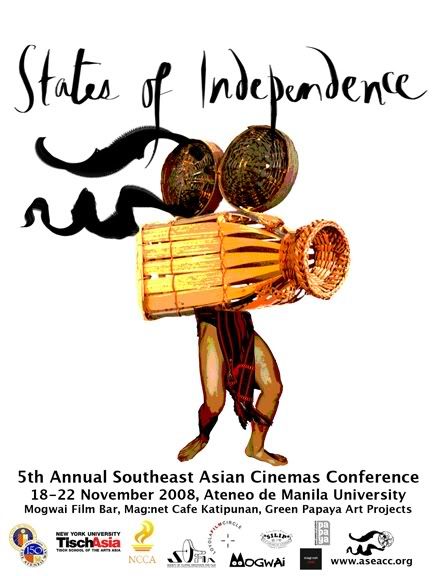
We are happy to announce the participation of Filipino music and sound artists *Teresa Barrozo*, *Tengal* and *Pow Martinez* in the 5th Annual Southeast Asian Cinemas Conference that will take place in the Philippines this coming November 18-22.

Barrozo, Tengal and Martinez are set to perform during the closing celebration of the ASEACC-Manila to be held in Mag:net Café Katipunan on November 22 from 8 PM onwards. Other invited artists include film director Lav Diaz who recently launched the soundtrack CD "Impiyerno".

The conference is an annual gathering of scholars, film practitioners and films enthusiasts from different countries in the region to primarily engage in discourse and build connections.

It is hosted by the *School of Humanities of the Ateneo de Manila University* together with the *Society of Filipino Archivists for Film* and *Loyola Film Circle*, in partnership with the *National Commission for Culture and the Arts* and the *New York University-Tisch School of the Arts Asia.* It is supported by independent art spaces Mogwai Film Bar, Mag:net Cafe Katipunan and Green Papaya.

Everyone is invited to join the conference and take part in the discourse. For further details and to register visit *www.aseacc. org.*

About the Artists

Teresa Barrozo is one of the emerging women composers of the country. Her compositions range from solo, chamber ensemble, orchestral, vocal, electroacoustic. Her works have been performed in the Philippines and in various Asian music festivals (Japan, Thailand). In 2007, she was one of the featured Filipino composers in the Asia-Pacific Weeks 2007 in Berlin, Germany. Teresa also works as a composer for theater, film and tv; and as an arranger for various choirs and orchestras.
Recent collaborations with filmmakers include music and sound design for "Sinungaling na Buwan" by Ed Lejano, music score for "Sakdal Laya" by Tey Clamor, "Tirador" by Brilliante Mendoza, "Possible Lovers" by Raya Martin, "The Thank You Girls" by Charliebebs Gohetia, and "Room 213" by Keith Sicat.

Tengal is a Manila-based interdisciplinary media artist, composer-musician, and filmmaker. He curates and organizes media art projects, has collaborated with various artists, and has performed in various shows in the Philippines and abroad. He attended the Berlinale Talent Campus 2006, in Berlin, Germany; the 5th Asia-Europe Foundation Art Camp: Re-Vision Bangkok | New Media Art and Interactivity, in Thailand; and most recently at Cellsbutton II: Yogyakarta International Media Art Festival, in Indonesia. He founded SABAW Media Art Kitchen – a not-for-profit, artist-run initiative and network platform for all kinds of information and communication carried via modern electronic media focused specially in the region of South East Asia.

Pow Martinez is a painter and an experimental/ electronic music composer.
He makes use of new and old media and whatever instrument he can afford to create music. When not playing with the Trojan Whores he performs by himself under the solo act, Nun Radar, and makes obscure albums. He also collaborates with performance artists and makes music for films.
When he's not doing any of these, he paints, exhibits and lurks the Internet. His collaborations with filmmakers include co-writing, with Ria Munoz, the original soundtrack for the 2006 Cinemalaya film Mudraks directed by Arah Badayos and Margaret Guzman.

Tuesday, October 21, 2008

CHOPPA OCT 08


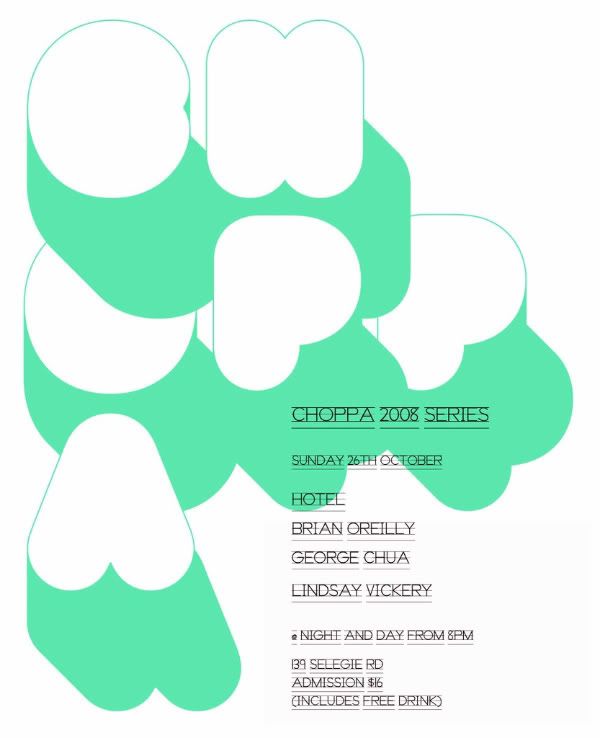
CHOPPA is back on Sunday 26th October bringing you more great improvised music from the Singaporean underground.

This month features we have the great pleasure of presenting the hardest working man in the Manilian underground, composer and multi-disciplinarian Tengal. He will be performing his Gangan Series with two other musicians Lindsay Vickery and Brian O'Reilly and Jerneja Rebernak as orchestrator. Gangan series is an open-ended system/composition that combines the interplay of sound and image (video, etc), and emphasizes the situational potential of live improvisatory performance of video and sound.

Local legend George Chua will be performing live electronics in his first Choppa appearance this year after the Choppa Festival in January. We debut a new group Hotel which is an off shoot of I\D, who are keeping the noise rock flame alive. Lindsay Vickery returns with a live electro/acoustic improvisation set with saxophone and electronics and Brian O'Reilly will debut Shroud Lines, a piece for solo bass, electronics, and moving images.

Tengal (Manila)

TENGAL is a Manila-based interdisciplinary media artist, composer-musician, and filmmaker. He curates and organizes media art projects, has collaborated with various artists, and has performed in various shows in the Philippines and abroad. He attended the Berlinale Talent Campus 2006, in Berlin, Germany; the 5th Asia-Europe Foundation Art Camp: Re-Vision Bangkok | New Media Art and Interactivity, in Thailand; and most recently at Cellsbutton II: Yogyakarta International Media Art Festival, in Indonesia. He founded SABAW Media Art Kitchen – a not-for-profit, artist-run initiative and network platform for all kinds of information and communication carried via modern electronic media focused specially in the region of South East Asia.
www.tengalgorhythm.blogspot.com

George Chua (Singapore)

George Chua is an artist whose sonic art may adopt the form of a performance, installation, or sound recording. He regularly performs solo work and group improvisations in art spaces, alternative spaces and theatres. His work involves a keen interest in the interdisciplinary nature of sound art and its extensive relationships with memory, invisibility, the body, theatre and cinema.

Lindsay Vickery (Australia)

Lindsay Vickery is active as a composer and performer across Europe, the USA and Asia. His music includes works for acoustic and electronic instruments in interactive-electronic, improvised or fully notated settings, ranging from solo pieces to opera and has been commissioned by numerous groups for concert, dance and theatre. He is also a highly regarded performer on reed instruments and electronics, touring as a soloist and with ensembles in many parts of the world.

Brian O'Reilly (USA)


shroud lines

for solo bass, electronics, and moving images.


for Eliane Radigue who taught me the different ways to listen...


The strategic fiction used to produce the structural relations in the work, is the erosion of form. Worn organic connections, self withering mechanisms, leaking detritual pools of acoustic ecosystems, weathered maps, the delicate stuttered buzz and click of insects left vibrating within glass slides, dendirfomic sub-terrain tendrils, and infected water tables.

Brian O'Reilly is the creator of various works for moving images, electronic/noise music, mixed media assemblage, multimedia installation, and is a contrabassist, focusing on the integration of extended playing techniques with electronics treatments.


Hotel

Comprising of members from I\D, the mammoth noise rock collective, Hotel is its minimal offspring where elements of avant noise, drone and free improvisation are militantly reflected, signaling a return to primal beats and the search of origin. Hotel is Harold Seah, Wei Nan and Ian Woo. Scatter
Rock!

Please join us on our sonic adventures!

@ Night and Day
139 Selegie Rd from 8pm
Entry is $16 and includes a complimentary drink

Friday, August 22, 2008

ACTION REACTION!


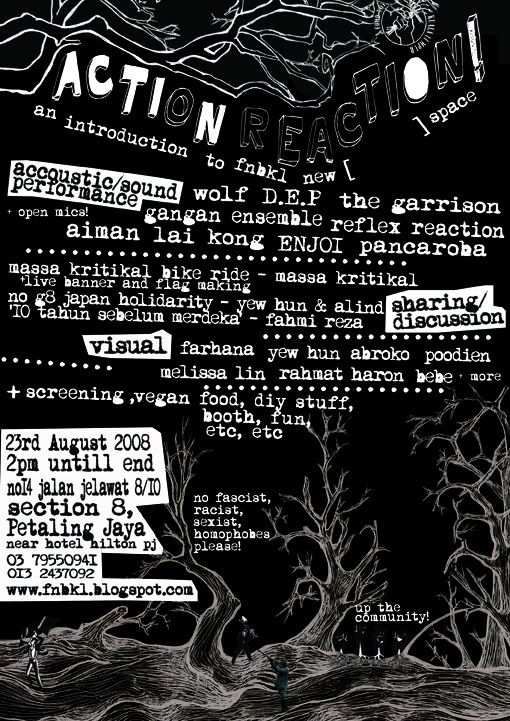
ACTION REACTION! -an introduction to fnbkl's new space – a day of happenings-community gathering, diy activism, discussion, sharing, skill sharing, exhibition and performances

23rd August 2008, Saturday, 2pm

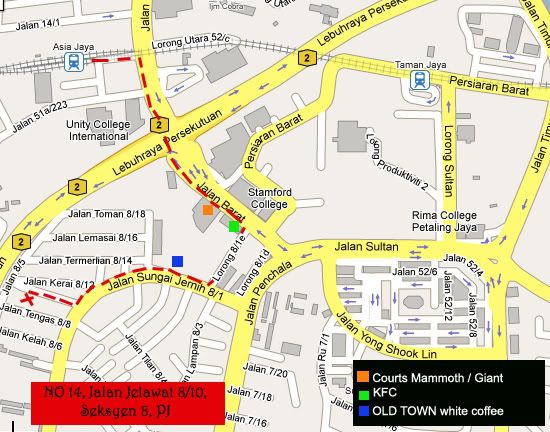
no14. Jalan Jelawat 8/10, Seksyen 8, Petaling Jaya.

THE (DE)PROGRAMS:

discussion/sharing

1. NO G8 japan holidarity – Yew Hun and Alind – 2.30pm to 4.30pm

The last G8 meeting was being held at Hokkaido Japan and for the first time friends from FNBKL and Kudeta join the massive protest and resist against capitalism, establishment, environment, and globalization. They will share their insight and experience there with vivid and vibrant photographs.

2. sepuluh tahun sebelum merdeka – Fahmi Reza – 4.30pm to 6pm

fahmi reza the director of the award winning film-'the most understanding human rights film' of freedom filmfest 2007 –will share his experience of making the film, the independent screening tour around the country, the present feedback, future plans and other things that he wants to share. http://10tahun.blogspot.com/

3. massa kritikal bike ride – Massa Kritikal – 6pm to 7pm

Massa Kritikal is a 'critical mass' chapter in Kuala Lumpur. They started the movement over here after the first bike parade in July last year. It's an autonomous decentralized movement where people make an effort to build a community of cyclist to ride in every city in the world as a direct action and to campaign for bicycle use in the city.

http://massa-kritikal.blogspot.com/

*whoever who wants to participate in the fun ride to fnbhouse pj from KL on the day of the event, massa kritikal will gather at the annexe central market, KL at 2.30 pm

4. community banner and flag making – Massa Kritikal – 7pm

the gang will invite people to participate in the banner and flag making that will be held at the park in front of the fnbhouse.

screening -7pm to 8pm

1. Tragedi Kg Berembang

-the documentation of wayang kadbod (shadow puppet) performed by the kids of Kg Berembang, telling their story of the tragedy of being evicted from their land and kampung by the city council and developers/corporation to give way to build condominiums.

shot by : Ebrahim Harris,

Edited by: Jimmy Choong

2006

19 minutes

2. A Place Called Chiapas

-documentary about Zapatista movement in Chiapas

92 minutes

accosutic/sound performance - 8pm to 11pm

1. wolf of spunky funggy

http://www.myspace.com/spunkyfunggy

2. D.E.P

http://dullentertainmentprogramme.blogspot.com

3. the garrison

http://www.myspace.com/beatgarrison

4. tengal and gangan ensemble (manila and KL)

Personnel:
Tengal (MNL) - electronics, mixer
Malek Lopez (MNL) - laptop
Caliph 8 (MNL) - samplers, drum machine
Jazmi Izwan Duo (KL) - laptop and guitar

http://www.gangan-series.blogspot.com/

5. reflex reaction

http://emacm.blogspot.com/

6. aiman of civil disorder and F.R.U

http://www.myspace.com/civildisorder153

7. lai kong

8. ENJOI

our bukit bintang buskers- percussion, didgeridoo, jembe, etc

9. pancaroba

+open mics!! (if we still have time.. should be end before 12pm)

visual/painting/drawing/photo/scratch

1. farhana

2. yew hun

3. abroko

4. poodien

5. melissa lin

6. rahmat haron

7. bebe

8. the mockmeat collective

to other groups, idealist, human rightist, artist ,activist ,tactivist, collectives:

Be impulsive, imaginative, and take this opportunity to bring down whatever you have (propaganda, fliers, zines, posters, old clothes, anything) to the space. Trade, sell, spread, or give it out for free. We welcome anything and everything! We need you!

Then again, if you really wanna, you can always call Poodien at 013 243 7092 or 03 79550941

MAP

Sunday, August 17, 2008

CELLSONIC!!!! (CELLSBUTTON #2)

Cellsbutton#02 2008, Yogyakarta International Media Art Festival 2008
1-21 August 2008

CELLSONIC!

INDEPENDENCE DAY (August 17th 2008)

09.00 - 03.00 PM

Admission: FREE

JL.KALIURANG KM 13

(PPPG KESENIAN / PPPPPTK)


Rundown

21:00 - 21:20 Toni Maryana

21:20 - 21:40 Monotron Prostitute

21:40 - 22:00 Apple Stereo

22:00 - 22:20 Cacat Nada

22:20 - 22:40 Mr.T

22:40 - 23:00 Tengal and Gangan Ensemble: Andreas Saigian (jogja), Julian Abraham (jogja), VJ Numberone (jogja), VJ Herbal (jogja), No. E (usa), Adam Sharples (uk), Jerneja Rebernak (slovenia)

23:00 - 23:20 Elang Ebby (Polyester Embassy)

23:20 - 23:40 DJ Navis

23:40 - 00:00 Lintang Enrico

00:00 - 00:20 Renee

00:20 - 00:40 Electrocore

00:40 - 01:00 Fat London

01:00 - 01:20 Criminal Cat

01:20 - 01:40 DJ Louvi

01:40 - 02:00 DJ Ones

02:00 - 02:20 DJ Dash

02:20 - 02:40 DJ Latex

02:40 - 03:00 DJ Wza

VJ Artist

The Departure

Public Space

VJ Number One

VJ Lost Siska

VJ Herbal

Kill Afternoon

Video Hacker

Wednesday, July 23, 2008

I, Tengal, 23 on 23

How many times in your whole life can you celebrate your birthday with the same number as your age, and as your date of birth? Only once.
Instead of having yet-again yearly lavish, extravagant celebrations of debauchery and drunken revelry; I opted to mark this day instead as a public and personal promise and as a constructive goal for the next 23 months. Last October 9, 2005, I made a list of albums, and promised myself the goal and ambition of creating and producing 20 albums until 2009. However, for the past 3 years, thru varied evolutions on interests, opening opportunities/possibilities, work/school, traveling, tumultuous emotional and personal experiences, and various pathetic reasons to be dormant etc, has kept me 13 albums short. So, I decided to add 3 more albums (so it becomes 23), extended my deadline, and most importantly, to commemorate this “special day and number” also to finish what my former background as a composer and musician had set forth to accomplish.

Therefore, I, Tengal, 23 years of age on the 23rd of July 2008, will complete 23 albums after 23 months. The new deadline is set on June 23, 2010. The albums will be released gradually or sporadically, and will be compiled and re-released simultaneously on July 23, 2010.

Here is the list of the 23 albums (which includes those I have completed, will do, and those currently in production).

(Subtitle, info) / [genre]


Completed:

1. Tengal - Drones for the Bored (Mga hugong para sa buryong) - (a series of drones for synthesizer, tape and prepared electric fan and mixer) [electro-acoustic, sound art, ambient, minimalist]

2. Tengal - Cinema for the Ear I (Idol: Bida/Kontrabida; 3 days of darkness OST) [soundtracks/film music]

3. Tengal/Conscript/Pow Martinez – feet conjoined hands [noise, improv, electro-acoustic]*

4. Tengal/Pow Martinez/Inconnu ictu: Live improvisation performance: S.A.B.A.W. Fiesta Volume 1: “This space for rent; the most obscure gig in 2005” [noise, electro-acoustic improv, electronic]*

5. V.A.
S.A.B.A.W. Anthology of Electronic, Noise, and Experimental Music 2006 [compilation]

6. EAT TAE
The way of attainment of genius or godhead as the development of the human brain... (EP) [genre-blender, murder jazz, musique concrete, avant rock, plunderphonics]

7. Tengal/Goh Lee Kwang/Arvie Bartolome – (untitled) [free improv, lowercase, sound poetry]*

* currently unreleased


Remaining:

8. Tengal – (untitled) [
miniature musique concrete, lowercase, minimal, glitch]

9. Tengal – Livevil [live, compilation]

10. Tengal – Cinema for the Ear II [soundtracks/film music]

11. Tengal – (untitled; 2nd album for Sequential Boredom Series) [sound art, electro-acoustic, lowercase, onkyo, glitch, compositional avant garde]

12. Tengal – (untitled; final album for Sequential Boredom Series) [field recordings, musique concrete, electro-acoustic, sound art]

13. Tengal – Regurgitating Rabbits [vocal, electronic, verbo-psycho poetry]

14. Tengal – POP MONSTER [plunderphonics, avant pop, lowercase, glitch]

15. Tengal/Arvie – (untitled) [electronica, post-rock, nu-gaze, glitch]

16. EAT TAE – PanRadio (DadadeathtranslatesPOP) [interactive radio play, murder jazz, musique concrete, plunderphonics, field recording, genre-blender music]

17. Happy Sauna [electrogrindcore, noisecore, gabba, idm]

18. V.A. – (untitled) [hiphop]

19. Tengal/Ria Munoz – (untitled) [electronica, lowercase]

20. Tengal/Elemento – (untitled) [noise, E-A improv]

21. Pinku! – Pinku! [jpop, miniature music]

22. Nipples – Crucifucked [miniature music, free noise, free jazz]

23. EAT TAE – Covers [unoriginal music, musique concrete, genre-blender music, plunderphonic]

Updated Final List of Participants for Cellsbutton Media Art Fest

Click Here.


Participants :

Miha Horvat (Slovenia)
Olivier Schulbaum (Germany)
Franck Ancel (France)
Pavel Sedlak (Czech Republic)
Emma Ota (UK/Japan)
Simon Laroche (Canada)
Deanna Herst (Netherlands)
Leila Abuhilal (UK)
Jan Torpus (Switzerland)
Mo Selle (Singapore)
Rene T A Lysloff (USA)
Craig Walsh (Australia)
Rob van Kranenburg (Netherlands)
No.E (USA)
Tengal (Philippines)
Shaun Gladwell (Australia)
Muid Latif (Malaysia)
Denis Jaromil Rojo (Netherlands/Italy)
Colette TRON (France)
Adam Sharples (UK)
Nancy Mauro-Flude (Australia)
Jerneja Rebernak (Slovenia)
Joe Addington (France)


Akbar (Bandung)
Taufik Obet (Jakarta)
Cokky Turnip (Medan)
Venzha (Yogyakarta)
Pradhono Rakhmono Aji (Yogyakarta)
Irene Agrivina (Yogyakarta)
Erin Citra (Batam)
Irine Stephanie (Bandung)
Julian Abraham (Yogyakarta)
Hendra Brawijaya (Bali)
Budi Adi Nugroho (Bandung)
Andreas Siagian (Yogyakarta)
Adhari Donora (Pekanbaru)
Marcello Vishnoe (Yogyakarta)
Gentur Galih / Vietnam (Yogyakarta)
Aldy Rento / unkl347 (Bandung)
Durga (Jakarta / USA)
Benny Wicaksono (Surabaya)
Bambang Rahmantyo (Semarang)
JackD2 (Yogyakarta)
ZeTH (Yogyakarta)
Prof. Jaka Widada (Yogyakarta)
Prof. Irfan Dwidja Prijambodo (Yogyakarta)
Daniel Hiu (Pontianak)
Politeknik Caltex Riau (Pekanbaru)
SMP 5 robot community (Yogyakarta)


Web / Recent works / Screening / Interview :

Usman Haque (UK)
Alex Bradley (UK)
ZTOHOVEN (Czech Republic)
BLENDID (Netherlands)
GENERATOR (Czech Republic)
Dirty Handz (France)
Laurie Rowan (UK)
Simon Laroche (Canada)
Rastasoft GNU/LINUX (Netherlands / Italy)
IAMAS (Japan)
Art Sensitive (France)
Stanley Ruiz (Philippines/USA)
Branko Andric (Austria)

DJ’s :

Fat London (France)
Billy / Embassy (Yogyakarta)
Sonny / Apple Stereo (Surabaya)
Wza / Stereowerk (Yogyakarta)
Rizal / Chronicle Therapy (Jakarta)
Sonny / Energyroom (Yogyakarta)
Adit Smoke / the projector (Surabaya)
Wattu / Chronicle Therapy (Batam)
Jojo / Manifesto (Solo)
Nouva / Manifesto (Solo)
Yance / Chronicle Therapy (Batam)
Reza / Manifesto (Solo)
Yudha / Manifesto (Yogyakarta)
Louvi / Energyroom (Yogyakarta)
Navis / Energyroom (Yogyakarta)
Adhit / Energyroom (Yogyakarta)


MC’s :

Erno / Energyroom (Yogyakarta)
Electrocore (Yogyakarta)
Mr. X (No-where)
XBO (Yogyakarta)

Live PA :

Electrocore (Yogyakarta)
Uncle 303 (Jakarta)
Terror Incognita (Semarang)
Criminal Cat (Surabaya)
Natural Airwave (Bandung)
KreziKultur (Yogyakarta)
Hengki Strawberry (Yogyakarta)
GODMODE (Yogyakarta)
Hello Good Boy (Yogyakarta)
Dubyouth (Yogyakarta)
Midijunkie (Yogyakarta)
Apple stereo (Surabaya)
Monotron Prostitute (Semarang)
MR-T (Surabaya)
Elang Eby/Polyester Embassy (Bandung)

VJ’s :

Translatic Lab (Solo)
Chrome-nymph (Bali)
Public space (Surabaya)
Vjnumberone (Yogyakarta)
alami_loopdown (Bandung)
The departure (Yogyakarta)
TribeMotion (Surabaya)
Mo Selle (Singapore)
LosTSisKa visual journey (Solo)
Pinxhoes (Bandung)
The dun’s visual (Yogyakarta)
The Herbal’s (Surabaya)
Video HACK (Surabaya)