The Sound of Things to Come
Woody Norris has reinvented acoustics. Big news for the world of music. Bigger news for advertising and crime-fighting and combat.
By Marshall Sella
No one ever notices what's going on at a Radio Shack. Outside a lonely branch of the electronics store, on a government-issue San Diego day in a strip mall where no one is noticing much of anything, a bluff man with thinning, ginger hair and preternaturally white teeth is standing on the pavement, slowly waving a square metal plate toward people strolling in the distance. "Watch that lady over there," he says, unable to conceal his boyish pride for the gadget in his giant hand. "This is really cool."
Woody Norris aims the silvery plate at his quarry. A burly brunette 200 feet away stops dead in her tracks and peers around, befuddled. She has walked straight into the noise of a Brazilian raid forest -- then out again. Even in her shopping reverie, here among the haircutters and storefront tax-preparers and dubious Middle Eastern bistros, her senses inform her that she has just stepped through a discrete column of sound, a sharply demarcated beam of unexpected sound. "Look at that," Norris mutters, chuckling as the lady turns around. "She doesn't know what hit her."
Norris is demonstrating something called HyperSonic Sound (HSS). The aluminum plate is connected to a CD player and an odd amplifier -- actually, a very odd and very new amplifier -- that directs sound much as a laser beam directs light. Over the past few years, mainly in secret, he has shown the device to more than 300 major companies, and it has slackened a lot of jaws. In December, the editors of Popular Science magazine bestowed upon HSS its grand prize for new inventions of 2002, choosing it over the ferociously hyped Segway scooter. It is no exaggeration to say that HSS represents the first revolution in acoustics since the loudspeaker was invented 78 years ago -- and perhaps only the second since pilgrims used "whispering tubes" to convey their dour messages.
As Norris continues to baffle shoppers by sniping at them with the noises he has on this CD (ice cubes clanking into a glass, a Handel concerto, the plash of a waterfall), some are spooked, and some are drawn in. Two teenage girls drift over from 100 feet away and ask, in bizarre Diane Arbus-type unison, "What is that?"
Norris responds with this affable mantra -- "In'nat cool?" -- before going into a bit of simplified detail; how the sound waves are actually made audible not at the surface of the metal plate but at the listener's ears. He doesn't bother to torment the girls with the scientific gymnastics of how data are being converted to ultrasound then back again to human-accessible frequencies along a confined column of air. "See, the way your brain perceives it, the sound is being created right here," Norris explains to the Arbus girls, lifting a palm to the side of his head. "That's why it's so clear. Feels like it's inside your skull, doesn't it?"
In the years Norris has demonstrated HSS, he says, that's been the universal reaction: the sound is inside my head. So that's the way he has started to describe it.
Just to check the distances, I pace out a hundred yards and see if the thing is really working. (I've tried this other times -- in a posh hotel in Manhattan, in another parking lot in San Diego -- but HSS is so often suspected of being a parlor trick that it always seems to bear checking. Norris pelts me with the Handel and, to illustrate the directionality of the beam, subtly turns the plate side to side. And the sound is inside my head, roving between my ears in accord with each of Norris's turns.
The applications of directional sound go quite a bit beyond messing with people at strip malls, important as this work may be. Norris is enthusiastic about all of the possibilities he can propose and the ones he can't. Imagine, he says, walking by a soda machine (say, one of the five million in Japan that will soon employ HSS), triggering a proximity detector, then hearing what you alone hear -- the plink of ice cubes and the invocation, "Wouldn't a Coke taste great right about now?" Or riding in the family car, as the kids blast Eminem in the back seat while you and the wife play Tony Bennett up front. Or living in a city where ambulance sirens don't wake the entire neighborhood at 4 a.m. Or hearing different and extremely targeted messages in every single aisle of a grocery store -- for instance, near the fresh produce, "Hey, it's the heart of kiwi season!"
No observer would expect a technological revolution -- any revolution -- from Elwood G. Norris. At 64, he has the demeanor of nothing so much as a highschool football coach. He lacks every single cliché of how inventors are supposed to act and look: the eccentricities of hairstyle, attire and vocabulary. He dresses as if he lives a life of Saturdays, perpetually in khakis and polo shirts. He is utterly normal -- even peculiarly normal.
Norris's office might easily be that of an assistant sales manager for something. Insurance, maybe, or drill fittings. His company, American Technology Corporation, is painstakingly nondescript, tucked away on the same unadorned and unadorable industrial-ghetto roundabout as Teradyne and Intel. Set randomly among the offices and cubicles of his 30 employees, Norris's own room is tiny and generic to a fault. There is a map of the world's ocean floors, also a plant of some kind. "Yep, it is small," he says, staring around him as if taken by surprise. "We're puttin' all our cash into production of HSS. That's the plan."
Norris wasn't the first to think of focusing sound waves. Far from it. Since the advent of the cone-shaped megaphone, every major acoustics company has traveled similar terrain. "If I'd known how many people had tried to invent this thing, and how smart those people were, I never would have touched it," he says. "Once we designed our own emitter -- which was not an obvious choice -- we patented every nut and bolt." Today, A.T.C. has 14 patents in the U.S. and hundreds pending worldwide. The company has spent millions on patents alone.
In the last year, Norris has not spent his time loitering at Radio Shacks and hoping for the best. A sampling of the companies that are in active talks with A.T.C. includes Wal-Mart, McDonald's, Dolby Laboratories, both Coca-Cola and Pepsi, major TV networks and film studios, cell phone makers and museums all over the world, to say nothing of the world's big-ticket speaker manufacturers. The U.S.S. Carl Vinson and the U.S.S. Winston S. Churchill are now equipped with A.T.C. speakers, and the Navy has expressed interest in outfitting every carrier in the fleet. "The L.A.P.D. wants to try it on high-crime alleys," Norris says. "The Army might use HSS for decoy troop movements. And Disney is nuts about it!"
Even Florida Power and Light has been given a taste. It seems endangered canaries have been sparking themselves to death on power lines and could do with some warning.
HyperSonic Sound, on its face, has some very alluring features for major companies. With HSS, there is no piston-like action that moves the air and causes the distortions heard from conventional speakers; there are virtually no moving parts at all, so the device generates next to no heat. All of which actually makes HSS equipment cheaper. More to the point, an HSS transmission can travel 450 feet -- at practically the same volume all along its path. Translated: at a concert, there's no need to melt the eyebrows of people sitting in the front rows. They'd hear the music at the same level as those lounging a football field away. "A multibillion-dollar company we're dealing with wants one that'll carry for a mile," Norris says. "And that is easily possible."
In the past months, Norris and his staff have made a further, key improvement to HSS -- instead of sending out a column of sound, they can now project a single sphere of it, self-contained, like a bubble.
This is all potentially very bad news for conventional speaker companies, which Norris insists are essentially box merchants. That is, given the fact that there are only a handful of "driver" manufacturers in the world, it's often merely design that distinguishes high-end from low-end audio speakers. It's never the C.E.O.'s of major acoustics firms who go pale when they see demonstrations of HSS; it's the engineers, a fact that delights Norris no end. "Those companies make slide rules and are being offered calculators," he says. "There's a smugness that goes with being a huge company. The big fish say, 'If it's so great, why didn't we invent it?' But how'd you like to be makin' buggy whips when cars came along?"
High technology, of course, is a slow-turning ship, and some trade heavyweights believe that HSS, while interesting, has real limits. Floyd Toole, a vice president of acoustical engineering at Harman International -- the $1.8 billion corporation that owns JBL and Infinity -- is skeptical. "HyperSonic Sound is not going to revolutionize the world, not going to replace the loudspeakers that we've all grown to love," Toole says. "I was once quoted, incompletely, as saying HSS is 'a great party trick' -- and it still is! Actually, it's also a very useful device. In basic communication, its applications are limited only by the imagination. Though, the last time I saw it, three months ago, it still had a lot of distortion. It had no low range. You wouldn't want to enjoy music using HSS, but it can really hit a target. Still, we're not threatened. Nor is Woody trying to take our domain."
Woody is not. His strategy is to avoid confronting major speaker firms -- for the time being. Better to start small, to look for places that currently don't have much to do with the acoustics trade. Museums, soda machines, produce aisles. "We're gonna go after the low-hanging fruit, places where you don't yet find sound, so HSS will not be regarded as a threat," he says, before showing some of the flick-knife steel that had to be buried in there somewhere. "And when we get strong, that's when we hit with a vengeance. We'll license with some Goliath of the industry -- a Sony or a Philips. Know how many new speakers were installed in 2002, from buses to boomboxes? Fifteen billion units. In'nat cool?"
Not surprisingly, people who've head of HSS have responded variously. On any given day, Norris might receive 17 e-mail messages from a company in Hong Kong begging to manufacture HSS -- and several from civilians who think he's either a genius or a psychopath. One man recently wrote to insist that Norris "be jailed" if he fields this product (curiously, sending this demand to Norris). And a woman wants to secretly install HSS in her lover's car or golf bag so that she may continually transit a message deep into his head: Marry Donna. ... Marry Donna.
Let some rave and others rage. It's all cool. Woody Norris is at his ease. He made his fortune 35 years ago and is now wealthy beyond his own ability to measure. His first invention was a medical product, simply because he was approached by a few friends who wanted to form a company but had nothing to sell -- and the man with the most money to invest was a doctor. So Norris went and bought a flashlight at Radio Shack (evidently his spiritual home), then picked up a piezoelectric crystal and fine-tuned his knowledge of the Doppler effect until he puzzled out a way to detect clots in blood vessels. This entire process took a Friday night and most of a Saturday. "It was called 'Transcutaneous Doppler,'" he recalls wistfully -- before adding, as a throwaway, "Eventually, it evolved into the sonogram."
There were a score of other inventions. Some panned out; some didn't. American Technology Corporation came into being in 1980 to nurture a long-play tape recorder, one that could fit 20 hours of sound on a regular cassette. Of course, CD technology put an end to all that. Shame, too, Norris says. They'd worked with drama students and everything -- had the whole New Testament recorded on one tape.
Despite his claim that he is "a fundamentally lazy man," Norris was always tinkering. There was his innovation of the digital recorder in 1994 (another Popular Science "Best of" pick); the world's tiniest FM radio, weighing less than one-quarter of an ounce; a tracking device for wayward toddlers. These days, Norris's new love is the AirScooter, a personal helicopter that takes no more than an afternoon to master. It's slow; smooth and lacks the complexities of an actual copter. And, as it has been whittled down to meet the government's "ultralight" standard -- weighing less than 254 pounds -- you need not be licensed to fly it.
Often, Norris says, inventions are the result of some left-field theory he blurts out before he has time to think it through. Scientists at NASA once got wind of an offhand remark he had made about wireless receivers and flew him to Texas; they'd been having trouble with boom microphones slipping around inside space helmets. "Suddenly I hear these words coming out of my mouth," Norris recalls: "'Well, I can give you a one-piece system so you won't need a boom mike at all. The sound can come through the bones in your head!' And the NASA guys were like, 'Yeah. Right.'" Thirty days later, Norris had a prototype, which the space agency grabbed with both hands. Norris translated the concept into an "all-in-your-ear headset" that came to be called Jabra.
"I did that technology in a weekend on my Mac at home!" he says, roaring like a con man. "And it's still selling. Some New Yorkers bought it for a couple million bucks -- and eventually it sold for $75 million to, I don't know, some Dutch company." Norris is often hazy on whatever happened to his original concepts, as he abandons them once they near the manufacturing stage. He just loses interest. With some (the digital recorder, for example), he's not even exactly sure if he's still receiving royalties. Presumably, his money managers know.
Of all Norris's inventions to date, though, it's HSS that could prove the most pervasive. The specter of a world shattered into billions of potential advertising spheres -- of inescapable, intrusive voices, as in a less-rainy version of "Blade Runner" -- has a way of concerning people.
To Norris's way of thinking, however, a shop with 100 confined spheres of sound is preferable to one where 12 speakers are blaring over each other. Of course, you might argue that Norris needs to believe that. After all, A.T.C. has seven years and over $40 million in this project. But that isn't exactly so. Besides being wealthy to the point where he's sheepish about it, Norris has already moved on to other inventions, a few books and even a sci-fi screenplay in which, he says, both Fox and Sony have shown real interest.
For the moment, though, HSS is unfinished business. As night must follow day, there are Defense Department applications. Norris and A.T.C. have been busy honing something called High Intensity Directed Acoustics (HIDA, in house jargon). It is directional sound -- an offshoot of HSS -- but one that never, ever transmits Handel or waterfall sounds. Although the technology thus far has been routinely referred to as a "nonlethal weapon," the Pentagon now prefers to stress the friendlier-sounding "hailing intruders" function.
In reality, HIDA is both warning and weapon. If used from a battleship, it can ward off stray crafts at 500 yards with a pinpointed verbal warning. Should the offending vessel continue to within 200 yards, the stern warnings are replaced by 120-decibel sounds that are as physically disabling as shrapnel. Certain noises, projected at the right pitch, can incapacitate even a stone-deaf terrorist; the bones in your head are brutalized by a tone's full effect whether you're clutching the sides of your skull in agony or not. "Besides," Norris says, laughing darkly, "grabbing your ears is as good as a pair of handcuffs."
If the U.S.S. Cole had been equipped with a HIDA system, the attack of October 2000 could never have succeeded. Most of the sounds under military consideration are classified, but some are approved for public consumption. One truly harrowing noise is that of a baby crying, played backward, and combined with another tone. As usual, Woody Norris is pleased to demonstrate. Woody Norris is pleased about everything.
Nimbly holding a big black plate, Norris stands with me in an A.T.C. sound chamber. Since he's poised behind the weapon, he will hear no sound once it's powered up: not a peep. "HIDA can instantaneously cause loss of equilibrium, vomiting, migraines -- really, we can pretty much pick our ailment," he says brightly. "We've delivered a couple dozen units so far, but will have a lot more out by June. They're talking millions!" (Last month, A.T.C. cut a five-year, multimillion-dollar licensing agreement with General Dynamics, one of the giants of the military-industrial complex.)
Norris prods his assistant to locate the baby noise on a laptop, then aims the device at me. At first, the noise is dreadful -- just primally wrong -- but not unbearable. I repeatedly tell Norris to crank it up (trying to approximate battle-strength volume, without the nausea), until the noise isn't so much a noise as an assault on my nervous system. I nearly fall down and, for some reason, my eyes hurt. When I bravely ask how high they'd turned the dial, Norris laughs uproariously. "That was nothing!" he bellows. "That was about 1 percent of what an enemy would get. One percent!" Two hours later, I can still feel the ache in the back of my head.
Norris grew up in Cumberland, Md., living in what may justly be called abject poverty. Until he was out of high school, indoor plumbing was not a feature of his home life. His mother was a devout Mormon who had a succession of husbands, none of whom was much of a force in the boy Norris's life. "I was embarrassed by some of my relatives," he says, making a rare break in eye contact. "All they ever did was drink. I had a terrible fear of not being normal -- of not seeming normal. So I went to the library and read every psychology book I could find. Anything about how normal people behave."
Even his identity seemed constantly in flux. Until he was 17, his surname was Harden. For reasons he remains hazy about, his mother deemed it necessary to haul the boy down to the courthouse and legally change his name at that rather advanced age. Discussing it, Norris's jaunty tone never falters, but a deadness in his eyes transmits -- quite directionally -- the blunt truth that these were dark times for him, rooms of his memory he doesn't care to revisit. His new life is brighter and built to his liking.
Despite his lumbering, sports-fan exterior, there were no sports in Woody's kidhood. His passion was visiting local radio-repair shops and talking them out of their scraps. "I must've ripped apart 20 or 30 radios," he says. "There were broken TV's in our chicken coop." He read everything about electronics he could lay two hands on. At an age where boys are immersed in Salinger or Henry Miller, young Woody was mesmerized by "Understanding Radio."
Through all those desperate attempts at normality, Norris remained a staunch Mormon. After serving in the Air Force, he spent 16 years living in Salt Lake City and achieved the level of high priest. He wore the "sacred undergarments," married his first wife in the Temple, the works. But by the early 90's, having previously written a book on Mormonism, he had lost his faith and now has a 1,000-page manuscript stashed away that, he says, takes strong issue with the Book of Mormon. Still, debunking Joseph Smith will have to wait. There are screenplays to polish. There are impossible machines to conceive, then abandon.
While Norris's work quarters are cramped and modest, his house is quite the other thing. To thrust some dime-store psychology upon him, Elwood Norris has sought to expunge the privations of his youth with garishly expressed prosperity.
The Norris estate is Mediterranean style, on what seems the highest hill near San Diego, surrounded by what appear to be a few counties of rolling coastal sage. Outside the place, overlooking its 44 acres, there's a vanishing-edge pool, a guest house, garage space for the family's three Lexus cars (with a slot to spare). Freshly antiqued Roman columns and statues of stallions blot out shards of the mountain view. Sculptured cherubs' faces, affixed to the house here and there, turn out to be modeled after Norris's youngest daughter, Tiffany, whereabouts unknown -- though, since the edifice is 20,000 square feet, no one would be the wiser if she were throwing a huge party in there somewhere.
Not a surface of the mansions' interior is deprived of gilt or silk or velvet; you'd swear it. There is a mind-bendingly well-stocked screening room, a pistol range, miniature models of towns assembled in rooms that seem designed specifically to showcase miniature models of towns. Only the wine cellar is underwhelming. Norris, the lapsed Mormon who hadn't a sip of alcohol or caffeine until the age of 50, is new to the stuff. Seven bottles of Something French are huddled together under a table at the back of the room, as if hiding in hostile territory.
Norris claims he wanted the house to be twice its size, but his wife put that idea to rest with all speed. Though he recognizes opulence when he sees it, much of the glitter still seems foreign to him. He knows that there are 335 miles of wiring in the place -- but can only approximate the number of bathrooms. He is sure there are six or seven bedrooms. I'll find out and get those numbers to you tomorrow," he says distractedly, as if these are business stats. "I'm better on other numbers. There are 60 surveillance cameras inside, 15 on the property. And 130 motion detectors. I can check out the whole place from any computer terminal in the world."
Out in a garage, Norris has stashed the prototype of his AirScooter; even this comparatively clunky incarnation acts on him like a tonic. Laying a loving hand on the thing, he marvels at the breakthrough of giving it two oppositely directed blades to counter the gyroscopic effect; a flexible pivot between the blades and the seat keeps the pilot ever-steady. "The fact that there are two blades and that it doesn't need a tail rotor," he says, "That was so not intuitive. There's a million bucks in this."
I ask the inescapable question: if anyone can buy and fly one of these helicopters, isn't there the possibility of, well, grim and horrible chaos?
"Oh, not at all," he says. "Look. There are hundreds of thousands of hang gliders in this country. Same with motorcycles. And you rarely even see one of 'em!"
The AirScooter's inception was typical of Norris's restless habit of simply walking away once an invention seems to have taken final shape. At A.T.C., once HyperSonic Sound was near completion, he started musing about the science of aviation. That was a frontier he'd never crossed, despite the hang-gliding scar that is lost in his well-creased forehead.
So he worked backward, as usual. "It went like this: I've always wanted to fly, but I don't like going to the airport," he says, ticking off his logic, one pink finger at a time. "I don't want to have to get a license. And I really don't want to go 100 m.p.h. So that set out the parameters right there. I consulted with Boeing engineers briefly, then raised $2 million in 20 minutes. My friends wanted in."
Though HSS and the minicopter are making headway -- the full-size AirScooter will be available to the public by year's end, with a starting price of about $50,000 -- Norris is deeply involved in two new projects. He refused to discuss these in any detail. His lab, in a rickety building near his house, smells of stingingly powerful glue and is cluttered with disparate apparatus; a gas chromatograph, transistor oscilloscopes, a one-million-Gauss magnet strong enough to tear fabric and human flesh alike. I ask if there's anything here that will betray Secret Things he's working on, but Norris has already disinfected the place of clues.
One project, he acknowledges, involves hydrogen and fuel cells. Of course, a man with secrets divulges first what he values least. It's Norris's way that, the more open he is with his first statement, the more he will clamp shut with his next. This is no exception.
The second project, he says, would make the rest of his career pale by comparison -- and he claims he has had early success. In all of this work, Norris has employed the tradecraft of his chosen profession to keep everything close to the vest. He buys his equipment at several machine shops so that no one can get an inkling of what he's doing. He hires separate scientists at separate universities to perform separate experiments -- and pays computer experts to train him to do the final, what he calls "fourth-level," stage of analysis. "I need to work that way," he says. "It's like when two guys discover gold together. One kills the other."
When I press him for a single word that would offer at least a vague idea of the Big Invention's category, he squints for a full minute and, seemingly in pain, whispers one out: matter. Then he searches my face for signs of recognition, half terrified that I'll guess what the technology is and half hoping I will. He is dying to say. It's his holy grail.
No one will ever know what makes inventors capable of staring at that which does not yet exist. Perhaps some form of hardship, in one's early years, is a factor. Edison went practically deaf as a boy; Alexander Graham Bell lost both his brothers to tuberculosis and was so sickly that his family moved to Canada in the hope of bracing him up. Then again, Benjamin Franklin and the Wright Brothers sauntered through childhood without a scratch. Woody Norris, in his formative years, was by no means unhealthy, but poverty left indelible marks. Maybe, in his case, that was a catalyst. Maybe mechanical figments were the cure when reality wasn't enough.
Lunch seems to offer Norris at his most philosophical. There's nothing like potato soup to remind you of the big picture. "I'm very simple," he says, quite seriously. "I have to be. I'm not very smart. I start broad, then go deep where I'm interested."
Focus is Norris's real meat and drink -- but he will always go broad before going deep. He never finished college. He didn't want some university to foist a narrow course upon him. Instead, he veered all over the map, from physics to the philosophy of religion. "I'm not even an engineer," he says, though he can only mean this in the most technical terms. "I don't have a college degree; I hire guys with college degrees."
Perhaps because ignorance has served him well (of the history of acoustics research, for example), he is protective of his limitations. He knows better than to swim in all the oceans. "These guys, like Hawking, they look too far away," he says. "They make it too complicated. Eleven dimensions, whatever. The answer is in front of your nose."
Suddenly, it strikes Woody Norris that he has been speaking to a clear plastic straw for the past several seconds: pondering it, turning it around in his hands and in his head. "This is so cool," he says, almost in awe. "It's so cheap, so elegant. People throw these away! Someday this thing is gonna lead to a real invention."

CAPTIONS:
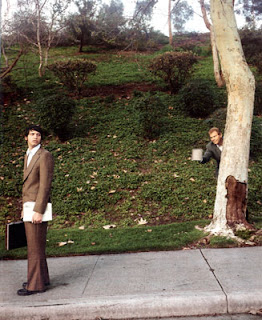
Woody Norris, lurking behind tree, demonstrates how he can spring unexpected sound on an unsuspecting passerby.
The fruits of Woody Norris's restless mind. At right, the world's tiniest FM radio, which measures just 1/2 by 1 1/2 by 1/4 inches and weighs less than 1/4 ounce. At far right, Norris's new love, the AirScooter, in flight. It can travel up to 70 m.p.h. and fly more than 10,000 feet above sea level -- and you don't need a pilot's license to fly it.
Far right, the young inventor in his 20's in Seattle. In 1968, Norris invented Transcutaneous Doppler, a patent sketch of which appears at right. Eventually, it would evolve into the sonogram.


 Posts
Posts


